Trust Center
The Control Boundary for AI Liability.
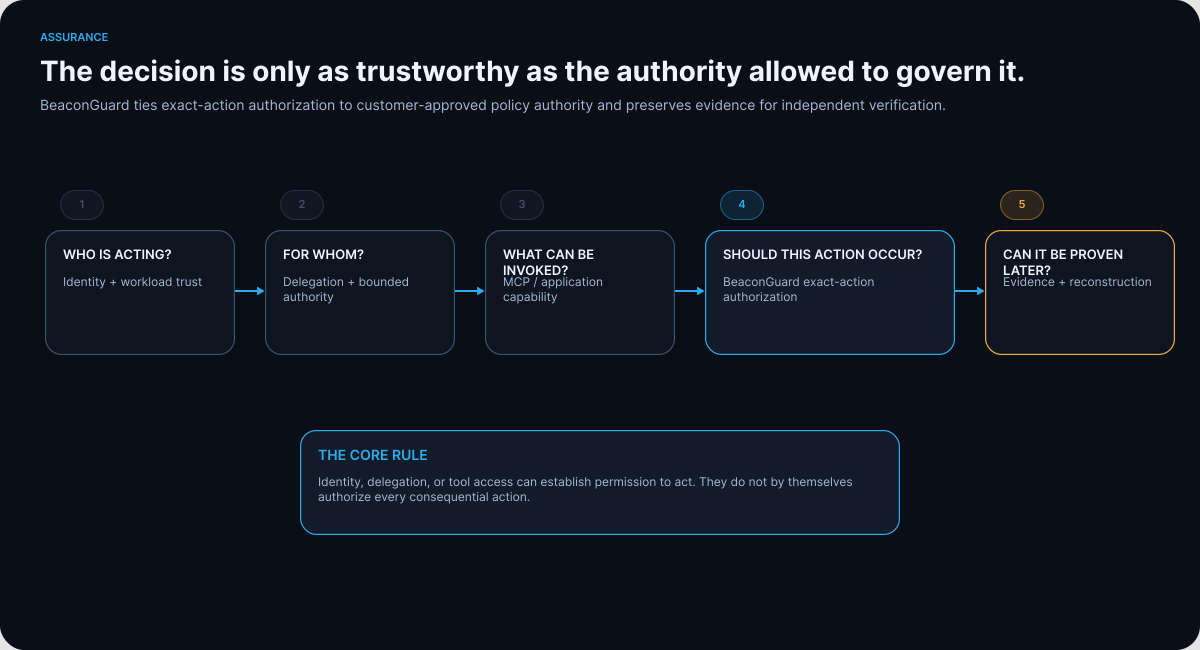
Trust in AI operations starts at the request boundary. BeaconGuard focuses on deterministic authorization, traceable decisions, and bounded control behavior for financial workflows.
Evidence Flow
Policy decision
Input and policy identity are evaluated.
Record
Decision result is emitted as structured evidence.
Review
Audit and assurance teams can reproduce context quickly.
Trust Model
BeaconGuard enforces policy at runtime and records decision context against explicit policy identity. The control boundary is where policy, not model behavior, decides execution rights.
Auditability
- Decision records for allowed and denied outcomes with policy identity.
- Policy identity, request context, and result captured at decision time.
- Decision lineage that supports investigation and external review.
Replayability
With the same policy snapshot and normalized input, BeaconGuard enables replay of decision outcomes for reconstruction and validation. That makes governance checks defensible over time.
Reviewer evidence focus
- BeaconGuard emits structured evidence for each request decision, including allow/deny outcome, policy identity, and normalized context.
- The evidence supports review of policy governance and decision context, including replay and audit preparation.
- BeaconGuard claims deterministic boundary governance behavior, explicit outcomes, and decision traceability within its control surface.
- BeaconGuard does not claim model-quality certainty or business-logic correctness, and does not replace broader transactional outcomes.
- External systems and downstream results still require cross-checking outside BeaconGuard, including identity, entitlement, and settlement controls.
Evidence Boundaries
BeaconGuard provides decision evidence, not model reasoning. It does not claim certainty about model quality, only about policy governance within the boundary where enterprise systems transfer control.