
Evidence, Verification, and Audit
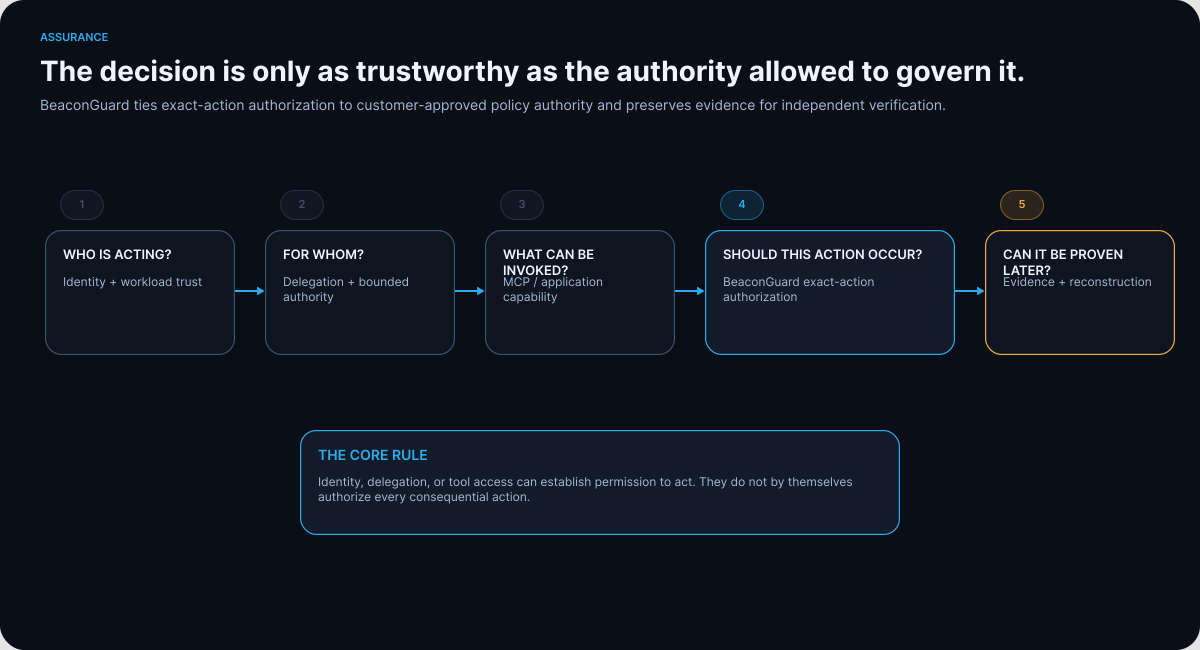
BeaconGuard produces authorization evidence for consequential-action decisions. The objective is not merely to record that an ALLOW or DENY occurred, but to preserve what exact action was evaluated, what verified policy authority governed it, and what context is required to check the decision afterward.
BeaconGuard does not make legal compliance guarantees and does not replace customer privacy, security, clinical, AML, fraud, SIEM, IAM, GRC, or records-management programs.
Evidence objectives
- Preserve ACTION ALLOW or ACTION DENY and the reason / failed condition
- Preserve the exact material-action identity
- Preserve the actor, agent, and delegated-authority context
- Preserve tenant and environment binding
- Preserve Active Verified Release and policy / playbook identity
- Preserve execution-grant identity and consumption state when applicable
- Preserve integrity information required for verification
- Support deterministic reconstruction using the recorded governing authority and normalized inputs
What makes the evidence different from a conventional audit assertion
A conventional audit event can state that a runtime used a particular policy version. BeaconGuard's assurance model is designed to connect the action decision to policy authority that was itself validated, signed, verified, and explicitly activated before it could govern production.
The evidence then preserves the release identity and exact-action identity required to verify and reconstruct the decision rather than relying only on a human-readable log message.
Illustrative Verifiable Decision Record content
- Timestamp and correlation identity
- Decision scope: consequential action
- ACTION ALLOW or ACTION DENY
- Material-action type and deterministic identity / digest
- Target system or resource context
- Actor / service / agent identity
- Delegation context
- Tenant and environment context
- Active Verified Release / manifest identity
- Policy / playbook identity
- Trust, freshness, and replay outcomes
- One-time execution-grant identity and consumption state when applicable
- Integrity-verification and reconstruction references
Deterministic reconstruction
When the recorded normalized inputs, action identity, and governing release are available, reconstruction is intended to:
- Resolve the verified policy authority that governed the historical decision
- Reconstruct the exact material action that was evaluated
- Re-evaluate the action under the recorded release and context
- Compare the reconstructed deterministic result with the recorded decision
- Support incident investigation and independent technical review
Qualified integrity and retention claims
Evidence can include cryptographic integrity protection and key-identified verification. Storage durability, append-only behavior, retention, external anchoring, and legal evidentiary treatment depend on the configured evidence provider and deployment controls.
BeaconGuard does not imply a public blockchain, third-party timestamping service, external anchor, universal append-only storage, or legal admissibility unless such a mechanism is explicitly configured and documented.
Failure visibility
Missing authority, invalid trust state, action-binding failure, replay, grant reuse, evidence failure, or internal authorization failure must fail closed and remain visible in the evidence path rather than silently falling back to permissive execution.