Financial AI Control Layer

Deterministic policy control for AI in financial workflows.

Deterministic Control. Verifiable Decisions.

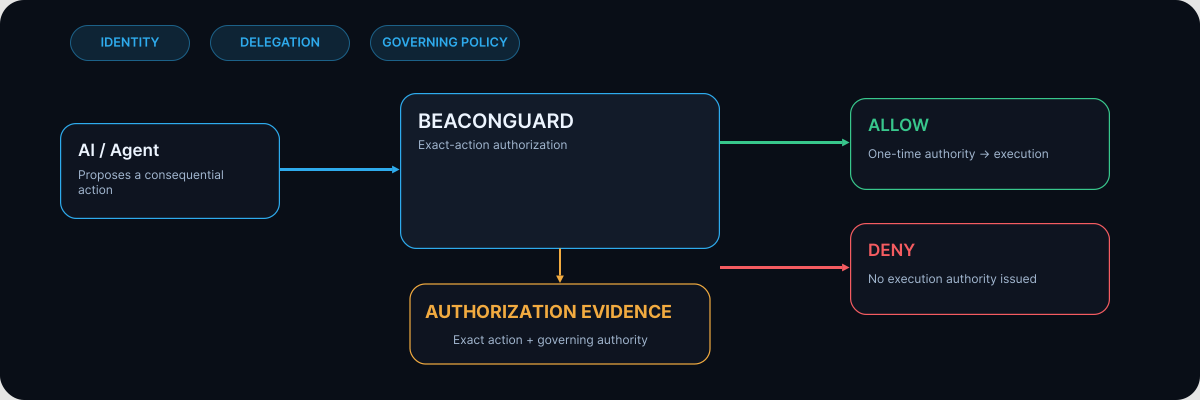
BeaconGuard inserts a non-bypassable policy and evidence boundary between financial applications and AI/model endpoints, returning explicit allow/deny decisions with context and preserving reviewable evidence for risk, audit, and security review.

No request reaches a model unless policy conditions are met.

Why financial institutions need this boundary

LLMs are useful in workflows like payment disputes, exception handling, and analyst support. BeaconGuard helps institutions use these capabilities without promoting model behavior to the authorization decision point.

LLMs are probabilistic, while a compliance/control boundary must be deterministic. BeaconGuard keeps model output out of the control decision path.

BeaconGuard enables AI adoption in sensitive workflows without making the model itself the control point.

What BeaconGuard controls

BeaconGuard is the control and evidence layer for AI request outcomes in sensitive financial workflows.

It does not replace applications, models, or transaction services. It decides only whether requests are permitted under explicit policy and returns deterministic outcomes with decision context for each event.

It preserves the exact boundary where policy is enforced: separate from model behavior, separate from prompt logic, and separate from downstream business data stores.

BeaconGuard is not the system of record. Operational telemetry may stay in existing enterprise systems.

BeaconGuard is not the transaction processor. It only gates and evaluates request intent.

It is the control and evidence layer between applications and AI use in sensitive financial workflows.

Where BeaconGuard sits in the request path

A request enters BeaconGuard before model execution and only proceeds when policy is satisfied.

Authorization logic is applied at runtime by a deterministic policy runtime, then returned as allow/deny plus explanation metadata.

LLMs are probabilistic systems and should not be the authorization boundary for sensitive financial workflows. BeaconGuard inserts deterministic policy control in the request path before model execution.

Request control boundary

Enterprise Application

Submits AI request with business context and authorization intent.

BeaconGuard Boundary

Evaluates policy and returns deterministic allow/deny with reasons.

AI / Model Endpoint

Executes approved requests and emits model output only.

Evidence & review stream

Decision Record

Decision context, policy identity, and outcome are emitted for audit and security review.

Decision outcomes are explicit and reviewable; execution occurs only after policy approval.

Evidence and replay surface

Application

Submits request context and policy intent

BeaconGuard

Evaluates policy with deterministic control

AI / Model Endpoint

Executes only approved actions with trace metadata

Every decision is reviewable with the same context used at evaluation time.

Example workflow: AI-assisted financial dispute resolution

A financial operations team uses AI to summarize dispute history, draft analyst support text, or recommend next actions during payment-dispute and account-exception handling. Because LLMs are probabilistic systems, they are not the authorization boundary for sensitive financial decisions. BeaconGuard sits between the financial application and the AI/model endpoint as the control and evidence layer.

It evaluates request context against centralized policy and returns explicit allow/deny decisions with context. It preserves structured evidence for security, risk, and audit review. If trust assumptions, policy conditions, or context are missing or out of bounds, BeaconGuard fails closed before the request reaches model execution.

Failure handling and operational control

Fail-closed control gate

If trust assumptions, policy conditions, or request context are missing, malformed, or out of bounds, BeaconGuard fails closed before the request reaches the model path.

Fail-closed behavior

When policy context is malformed or incomplete, BeaconGuard defaults to deny and records the block condition.

Control assertions

Explicit allow/deny decisions remain reproducible and linked to policy identity and input context.

Replayability

Equivalent requests under the same policy state return equivalent outcomes for audit validation.

Review readiness

Decision artifacts are structured for security and risk teams to reconstruct control behavior.

Deployment boundary and responsibility

BeaconGuard is designed for controlled deployment postures where control decisions remain bounded at the policy layer and auditable by operational and risk teams.

Trust and review surface

Risk, security, and audit stakeholders can use BeaconGuard as the review layer for runtime controls.

Security and risk teams consume the same decision context needed for review-ready governance.

Design partner review path

Design partners help validate policy boundaries, fail-closed behavior, and evidence requirements before production rollout.

Learn how we run design partner evaluations

Get Started

Start with the architecture and move into deployment control boundaries and review planning.