
Enforcement Runtime
The BeaconGuard enforcement runtime determines whether an exact consequential action is authorized to execute under the current verified customer governance state. Request admission, identity validation, MCP invocation, A2A delegation, and provider access are inputs to this path; they are not substitutes for the action decision.
The runtime is designed to be:
- Deterministic
- Fail closed
- Exact-action bound
- Single-use at the execution-grant boundary
- Governed by verified production policy authority
- Verifiable and reconstructable through authorization evidence
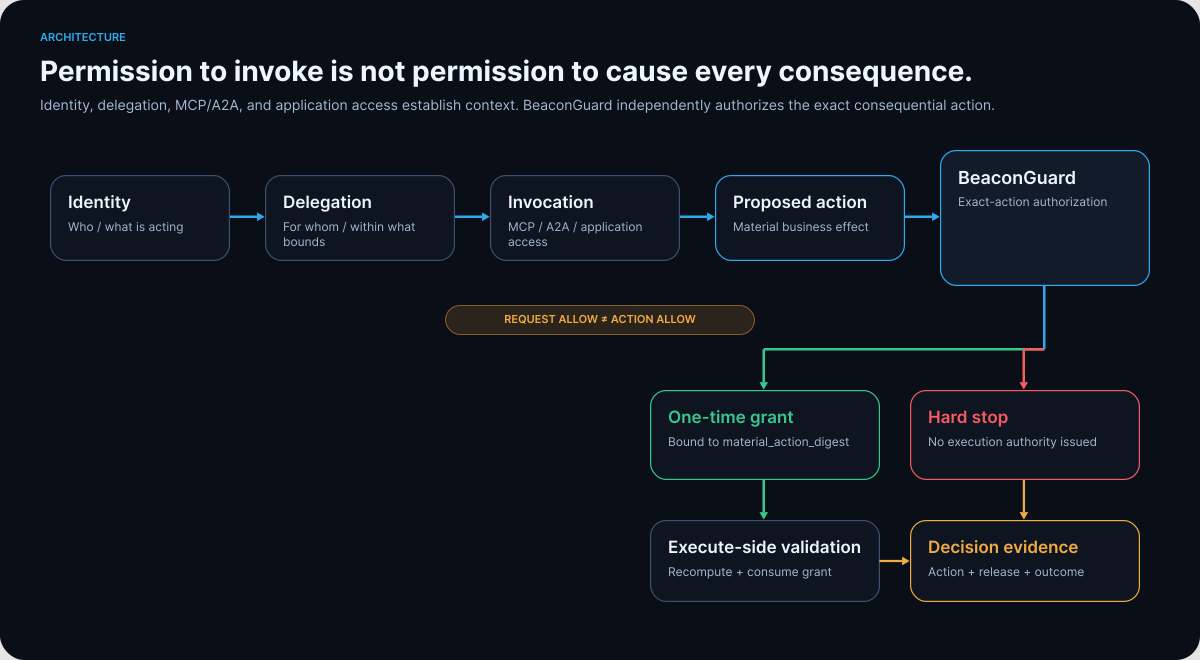
Two distinct authorization events
Request admission
Determines whether the actor, delegated authority, context, and invocation path are valid enough to reach the requested AI, agent, provider, or tool.
Consequential-action authorization
Occurs after the proposed result or side effect is known. BeaconGuard evaluates the exact material action under the Active Verified Release and returns ACTION ALLOW or ACTION DENY.
REQUEST ALLOW ≠ ACTION ALLOW.
Material-action contract
The proposed side effect is converted into a canonical material-action representation and deterministic action identity. Authorization applies to that identity. The contract prevents broad request permission from silently expanding into different downstream actions.
Decision contract
| Result | Meaning |
|---|---|
| ACTION ALLOW | The exact material action satisfies current verified policy, trust, identity, delegation, tenant, environment, and action conditions. One-time execution authority may be issued. |
| ACTION DENY | The exact material action is not authorized. No execution authority is issued and no side effect may occur. |
One-time execution grant
An ALLOW result can produce execution authority bound to the exact material-action identity. At the execution boundary:
- The executor receives the action and one-time grant.
- The executor recomputes the material-action identity.
- The recomputed identity must match the authorized identity.
- The grant must be valid, unexpired, unrevoked, and unused.
- The grant is atomically consumed for the authorized side effect.
Binding mismatch, replay, grant reuse, invalid trust state, or missing required state fails closed.
Runtime source of authority
The Active Verified Release is the policy authority permitted to govern production authorization. Drafts, unsigned artifacts, inactive releases, mixed policy material, and unverifiable releases are not runtime authorities.
Evidence emission
Each action decision produces integrity-protected authorization evidence tied to the decision, exact material-action identity, governing release, and relevant authority context. The evidence is designed to support verification and deterministic reconstruction.
Failure semantics
The runtime returns DENY or refuses execution when required authorization state cannot be established.
- Identity or delegation invalid, expired, revoked, or outside bounds
- Tenant or environment mismatch
- Freshness or replay failure
- Active Verified Release absent or unverifiable
- Material-action canonicalization or binding failure
- Required approval or policy condition absent
- Execution-grant mismatch, expiry, or reuse
- Required evidence or shared trust dependency unavailable
- Internal authorization error
Silent fallback or permissive continuation is prohibited.