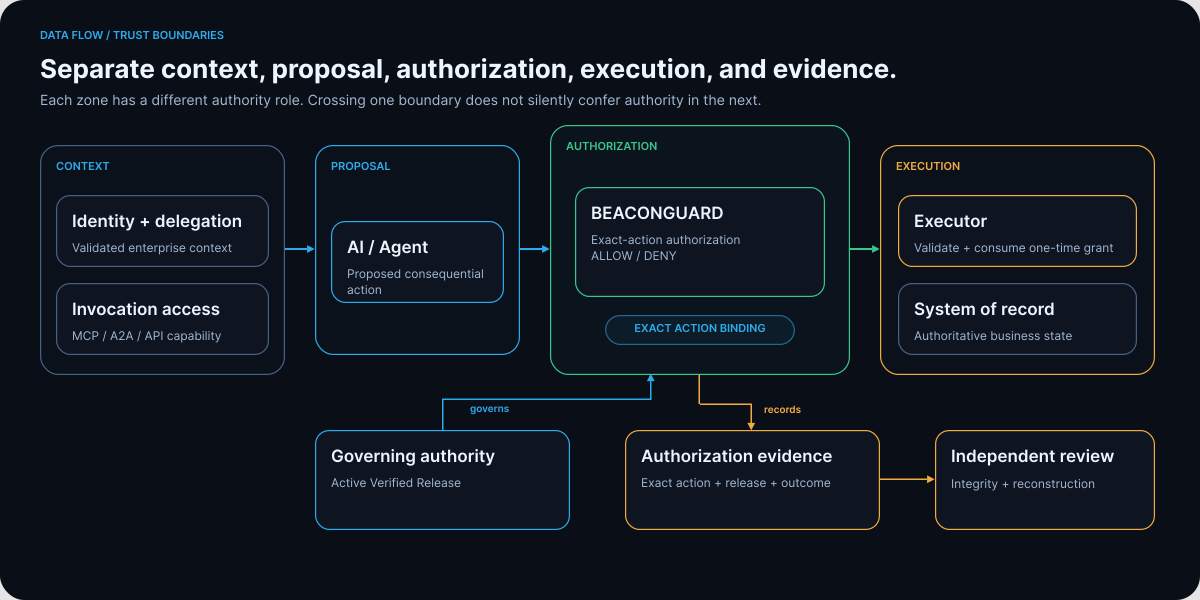
Data-Flow Threat Analysis
This page identifies the trust boundaries, data flows, threat conditions, and deterministic enforcement responses associated with a BeaconGuard-governed request. It supplements the System Architecture and Threat Model documentation.
Data-flow and trust boundaries
Customer-controlled boundary
1. Request context
2. Trusted identity context → runtime verification (customer-controlled; IdP does not decide ALLOW or DENY)
3. Normalized request context + identity context → runtime
BeaconGuard runtime boundary
4. Active release → evaluation
5. Replay verify ↔ shared state
6. Write decision record → evidence-provider boundary
Evidence-provider boundary
7. Write success / verification result → runtime outcome path
Retention, integrity, and durability depend on the configured evidence provider — not universally append-only.
Outcomes after successful evidence persistence (mutually exclusive)
Outcomes after evidence persistence (mutually exclusive)
Governed downstream-system boundary
DENY path (flow 9) returns to the Enterprise Application with no governed-system execution.
Management-plane boundary (outside request path)
10. Administration
11–12. Controlled distribution → verification → activation
13. Monitoring or review may read evidence where configured. Evidence retention and integrity remain provider-dependent.
Text version
- Customer-controlled: Enterprise Application → Optional System Connector (request context).
- Customer Identity Provider supplies trusted identity context for runtime verification; does not decide ALLOW or DENY.
- Normalized request and identity context enter the BeaconGuard Runtime Boundary.
- Active Verified Release feeds deterministic evaluation.
- Replay verification uses Shared Replay State.
- Runtime generates and writes the Verifiable Decision Record to the separate Evidence-provider boundary.
- Write success / verification result returns to the outcome path; outcomes depend on successful evidence persistence.
- ALLOW forwards to the governed system only after successful evidence persistence.
- DENY returns to the Enterprise Application with no downstream execution.
- Operator / Administrator → Control Plane (outside request path).
- Control Plane manages Compliance Playbook release lifecycle through distribution, verification, and activation.
- Active Verified Release feeds runtime evaluation (flow 4).
- Monitoring or review may access evidence where configured; provider-dependent retention and integrity.
1. Scope and trust boundary
BeaconGuard inserts a Runtime Control Boundary between an enterprise application or workflow and a governed AI, API, or automated system. The management plane produces releases; the runtime data plane evaluates each request against an Active Verified Release and returns ALLOW or DENY before governed execution. The Control Plane is outside the per-request path. The customer IdP does not make the BeaconGuard decision.
Out of scope for this page:
- Product marketing claims
- Legal compliance certification
- Replacement of customer systems of record
2. Data-flow sequence
- Enterprise Application / Workflow submits a request.
- Optional System Connector maps source protocol and context.
- Request Validation and Context Normalization checks required structure.
- Trust, Freshness, and Replay Checks validate admission conditions.
- Deterministic Playbook Evaluation applies the Active Verified Release.
- BeaconGuard determines ALLOW or DENY.
- A Verifiable Decision Record is persisted.
- ALLOW may proceed to governed execution; DENY hard-stops.
- Evidence supports replay, verification, and governance review via the configured evidence provider.
3. Trust inputs
Typical trusted inputs include signed or otherwise verified request metadata, workflow identity, user role, source-system trust, approved-pathway status, request identifiers, timestamps, freshness windows, and the Active Verified Release selected for evaluation.
Missing or invalid required inputs fail closed as DENY.
4. Threat conditions
| Threat | Boundary | Control | Enforcement response | Residual responsibility |
|---|---|---|---|---|
| Malformed request | Runtime Control Boundary | Request Validation and Context Normalization | DENY because required structure is missing or invalid | Application request construction |
| Missing trusted context | Runtime Control Boundary | Trust checks and playbook requirements | DENY because required context is missing | Identity and source-system trust configuration |
| Invalid signature or trust signal | Runtime Control Boundary | Trust and signature checks | DENY because trust cannot be verified | Key and identity-provider operations |
| Stale request | Runtime Control Boundary | Freshness checks | DENY because freshness cannot be verified | Clock and request-timing practices |
| Replayed request | Runtime Control Boundary | Replay checks | DENY because the request appears replayed | Replay-state provider and deployment configuration |
| Inactive or unverified release | Release Verification and Activation | Release verification before activation | DENY because no verified active release is available | Release distribution and activation operations |
| Unauthorized pathway | Deterministic Playbook Evaluation | Active Verified Release pathway controls | DENY because the pathway is not approved | Pathway governance and playbook authoring |
| System Connector manipulation | Optional System Connector | Connector cannot evaluate controls or bypass fail-closed enforcement | DENY when normalized context fails validation or trust checks | Connector hardening and monitoring |
| Downstream execution misuse | After ALLOW | BeaconGuard does not own post-ALLOW business logic | Not a runtime permission bypass; ALLOW only permits governed execution | Customer application and model-risk controls |
| Evidence-provider failure | Evidence path | Verifiable Decision Record emission; storage durability is deployment-dependent | Runtime permission remains ALLOW or DENY; retention and integrity depend on provider configuration | Evidence-provider and customer infrastructure |
5. Enforcement behavior
Runtime permission results are binary:
- ALLOW — required controls are satisfied; after evidence persistence, governed execution may proceed.
- DENY — execution is prevented; no downstream execution occurs.
When required approval is absent, BeaconGuard returns DENY with a deterministic reason indicating that approval is required. An illustrative reason style is APPROVAL_REQUIRED. Governance or human review may follow from the Verifiable Decision Record; review does not permit execution.
6. Evidence and review
Every deterministic result produces a Verifiable Decision Record that preserves decision context, release identity, control result, and outcome. Evidence is designed for replay and verification and supports audit and governance review. Retention and integrity protection depend on the configured evidence provider and shared customer deployment responsibilities. Append-only or immutable storage is not assumed unconditionally.
7. Residual risks
BeaconGuard does not remove residual risk from:
- Misconfigured identity providers or trust sources
- Incorrect Compliance Playbook authoring
- Compromised signing keys
- Evidence-provider outages or misconfiguration
- Misuse of allowed outputs after an ALLOW result
Those risks remain shared with customer operations and are addressed in the broader Threat Model.