
DEPLOYMENT & INTEGRATION
Keep the authorization boundary on the execution path
BeaconGuard deploys between the proposed consequential action and the enterprise executor that can create the side effect. The core deployment invariant is that the action cannot reach execution without crossing the BeaconGuard boundary.
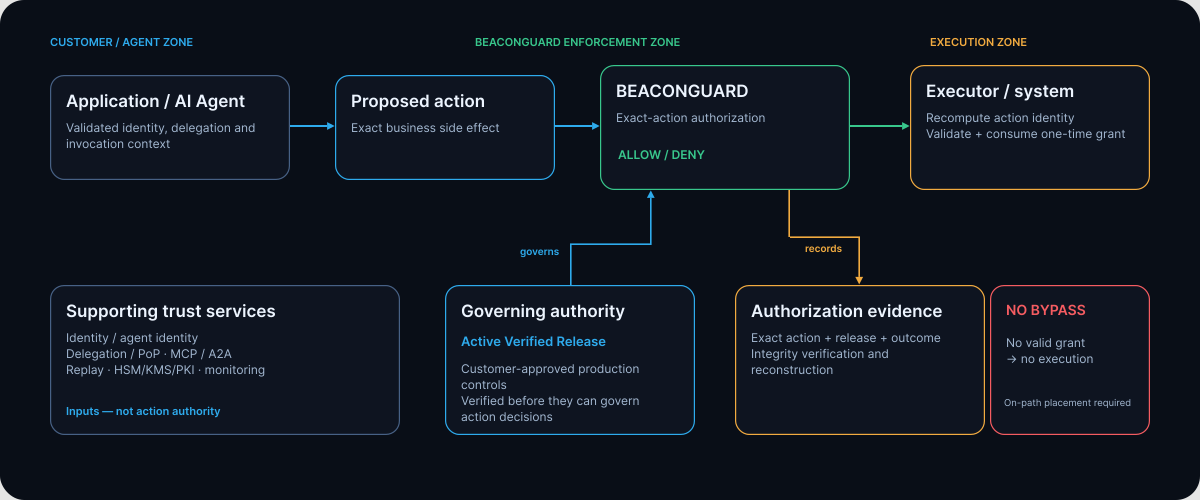
Integration contract
| Domain | Establishes | Does not establish |
|---|---|---|
| Identity / delegation | Who or what is acting, for whom, and within what bounds | Automatic authority for every downstream side effect |
| MCP / A2A / API / application | Invocation and capability path | Final action authorization |
| AI / agent | A proposed result or consequential action | Execution authority |
| BeaconGuard | Exact-action ALLOW or DENY under governing policy authority | Business-system execution or source-of-record ownership |
| Executor / system of record | Validated execution and resulting business state | Policy authority |
| Evidence provider | Integrity, retention, and reconstruction material as configured | Runtime permission to execute |
Runtime sequence
- Validate required identity, delegation, tenant/environment, freshness, and replay context.
- Admit the required invocation path and allow the AI or agent interaction to produce a proposal.
- Construct and canonicalize the exact material action that would create the side effect.
- Authorize that action under the current governing policy authority and return ALLOW or DENY.
- Persist authorization evidence; ALLOW may issue one-time execution authority bound to the action.
- The executor recomputes the action identity, validates and consumes the grant once, then creates the side effect.
Production placement requirements
On path
The application or connector architecture must prevent a consequential action from bypassing BeaconGuard.
Verified authority
Only verified and explicitly activated customer policy authority may govern production decisions.
Executor enforcement
Executors reject missing, mismatched, expired, revoked, or previously consumed execution authority.
MCP and A2A
MCP and A2A are supported as invocation and delegated-authority context. They do not replace the exact-action decision.
Invocation permission and delegated authority constrain the decision; they do not equal final action authority.
Environment and evidence boundaries
Development, validation, and production should use explicit trust, release, key, replay, and evidence boundaries. Evidence-provider durability, retention, append-only behavior, and external anchoring remain deployment-dependent.