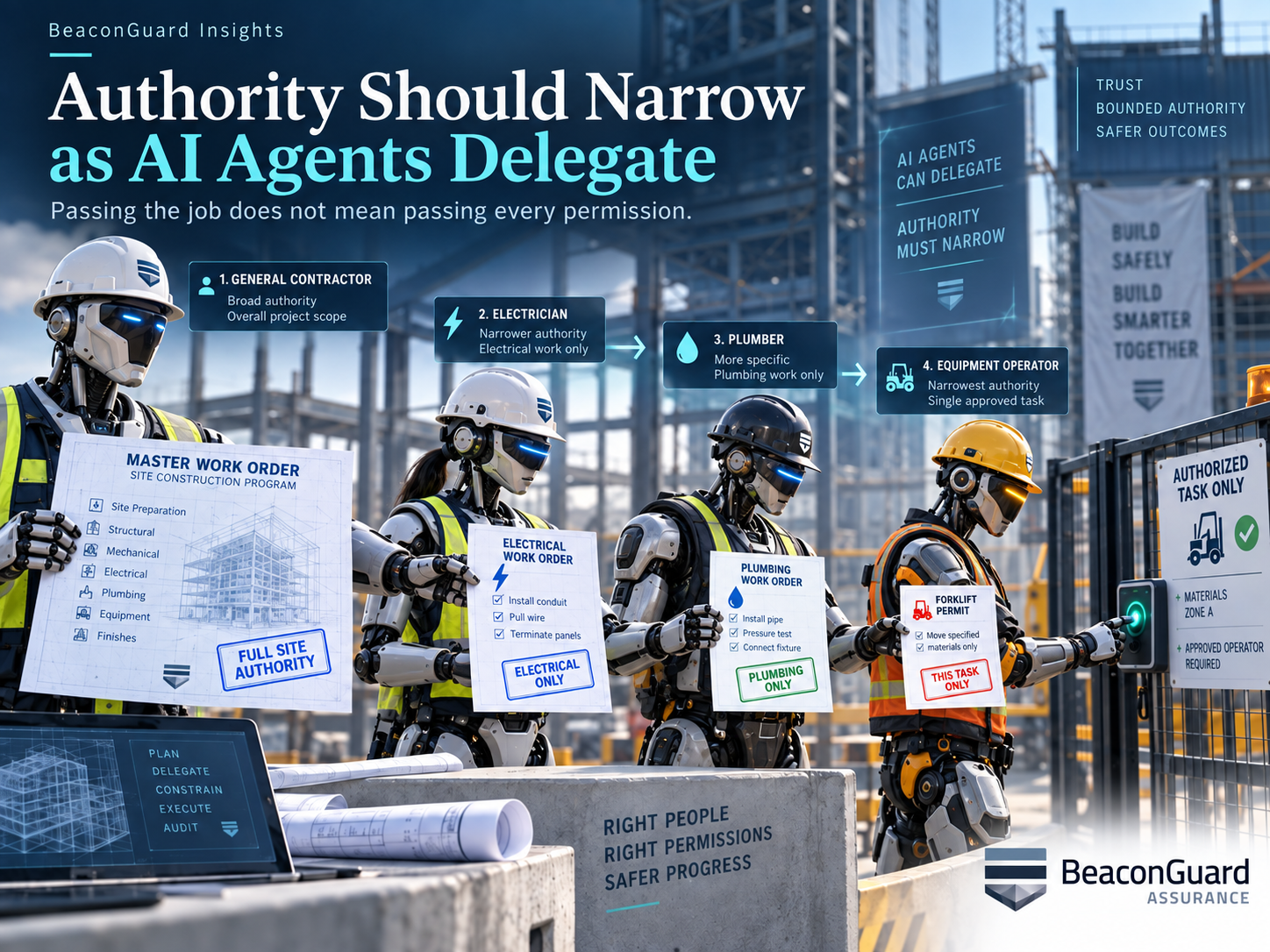
When one AI agent delegates work to another, responsibility may transfer, but authority should not automatically transfer in full. Delegated authority should remain explicit, bounded, and capable of narrowing across an agent chain. Final consequential action still must be independently authorized before execution.
What CAPMAS reveals about bounded delegation, privilege attenuation, and authorization across multi-agent workflows
Controlling thesis
When one AI agent delegates work to another, responsibility may transfer, but authority should not automatically transfer in full. Delegated authority should remain explicit, bounded, and capable of narrowing across an agent chain. Final consequential action still must be independently authorized before execution.
CAPMAS is one architectural example of this approach: combining semantic privilege scoping, attenuable credentials, and independent verification before execution. It is not proof that one mechanism is the only solution, and it is not a BeaconGuard implementation claim.
The next AI authorization challenge is not only what an agent can do. It is what happens when another agent takes over.
Single-agent AI workflows already create authorization questions:
- Which actions can the agent perform?
- Which systems can it access?
- Which user authority can it represent?
Multi-agent systems introduce another layer.
An agent may plan a task, delegate part of the work, and call another specialized agent. That second agent may have different capabilities, different context, and different responsibilities.
The authorization question changes:
When work moves from one agent to another, does authority move with it?
Or does the handoff create a new authorization decision?
Recent research into CAPMAS (Capability Management for Agentic Systems) provides one example of how delegated authority can be constrained as execution moves through an agent chain.
Why delegated authority must narrow
CAPMAS is an academic research system described in arXiv:2609.06500. The paper presents a capability-based approach for multi-agent authorization using:
- semantic mapping of task requests into bounded privilege sets;
- attenuable capability credentials;
- delegation-chain tracking;
- and IAM verification before consequential actions execute.
The central architectural idea is that an agent receiving delegated work should not automatically inherit the full authority of the upstream actor.
Instead, authority can be narrowed.
A downstream agent receives only the capabilities required for the delegated task.
This creates a delegation chain where authority can move forward while remaining bounded.
Delegation is not the same as privilege inheritance
Traditional enterprise systems often rely on established identity and access management patterns.
A user authenticates.
A system evaluates permissions.
A service receives an access token or delegated authorization.
Those mechanisms remain important.
CAPMAS explores a different design point for environments where multiple autonomous agents may repeatedly hand work between each other.
The challenge is not replacing identity.
The challenge is preventing an agent handoff from silently expanding the authority available to the next participant.
A useful architectural distinction:
Identity answers who is acting.
Delegation answers what authority is being transferred.
Authorization determines whether the requested action is allowed.
CAPMAS focuses on making the second category more explicit in multi-agent chains.
How CAPMAS narrows delegated authority
The paper describes a process where a natural-language request is mapped into a bounded privilege set.
That initial privilege set can then be attenuated during delegation.
Each additional handoff can add restrictions rather than expand access.
The result is a monotonic model:
Authority can remain the same or decrease.
It does not automatically grow because additional agents become involved.
This is an important property for agentic systems because the number of participating agents may increase while the authorized scope should remain controlled.
Capability attenuation still requires independent enforcement
A critical distinction:
Local delegation is not the same as final authorization.
CAPMAS uses capability attenuation during agent handoffs, but the paper still describes IAM verification before the consequential service action executes.
The final system decision remains separate from the agent's reasoning process.
This separation matters because an agent can correctly follow instructions and still operate outside the intended authority boundary if the authorization decision is not independently enforced.
What the CAPMAS results show — and what they do not
The CAPMAS authors report evaluation results across their experiments, including semantic privilege selection and performance comparisons.
These results should be interpreted within the scope of the paper.
The authors report high perfect-bundle capture rates in their semantic privilege-selection experiments.
However, these results are not authorization accuracy measurements.
The same evaluations also report relative over-privilege because broader privilege bundles can improve task completion while increasing unnecessary permissions.
This demonstrates a continuing security-utility tradeoff:
Tighter privilege selection reduces unnecessary authority.
Broader privilege selection improves the likelihood of completing complex workflows.
The correct operational balance depends on the environment, risk tolerance, and policy requirements.
The importance of threat models
CAPMAS presents its strongest security properties under stated assumptions, including honest-but-curious infrastructure and non-malicious agent-code assumptions.
That distinction matters.
A system can provide strong guarantees against accidental overreach, unexpected delegation expansion, or untrusted inputs while still having different considerations against actively malicious participants.
The paper discusses limitations including potential information leakage from plaintext caveats, memory contamination concerns, threshold selection challenges, and dependence on IAM infrastructure.
These are not failures of the approach.
They illustrate that authorization architecture remains a system-design problem involving tradeoffs.
Why this matters for enterprise AI authorization
Enterprise AI adoption is moving from individual assistants toward workflows where multiple systems and agents cooperate.
That creates a new authorization surface:
- an initial user request;
- one or more AI planners;
- specialized sub-agents;
- external tools;
- enterprise systems of record.
The question becomes whether authority can remain bounded throughout that chain.
A future enterprise authorization model may need to answer:
- What authority was originally granted?
- What authority was delegated?
- What restrictions were added?
- Which agent performed each step?
- Which system independently approved execution?
The ability to reconstruct that chain becomes increasingly important as AI systems become more autonomous.
BeaconGuard interpretation: authorization assurance across agent boundaries
CAPMAS provides one research example of how multi-agent systems may manage delegated authority.
BeaconGuard's broader authorization-assurance perspective is focused on the same category problem:
Consequential AI actions require an authorization boundary independent from AI reasoning.
The relevant lesson is not that enterprises must adopt CAPMAS, Macaroons, or any specific mechanism.
The broader architectural principle is:
AI systems can propose, plan, and delegate.
The authorization decision must remain explicit, bounded, and independently verifiable.
Conclusion
Multi-agent AI introduces a new problem beyond granting access to an individual system.
Authority now has to survive delegation.
The challenge is ensuring that every delegation step preserves the intended scope of authority rather than inheriting unlimited privilege from earlier context.
CAPMAS represents one research direction toward bounded delegation through attenuation and independent verification.
As agentic systems mature, authorization architectures will need to evolve from answering:
"Who has access?"
toward answering:
"What authority was delegated, how did it change, and why was this action allowed?"
# Source Notes and Claim Classification
Primary evidence
CAPMAS: Capability Management for Agentic Systems arXiv:2609.06500
Classification: - Verified facts about the paper architecture. - Author-reported evaluation results. - Author-described threat model and limitations.
Author-reported results
The following remain attributed to CAPMAS authors:
- semantic privilege-selection evaluation results;
- benchmark latency comparisons;
- privilege reduction measurements;
- prototype evaluation results.
These are not treated as independent enterprise validation.
BeaconGuard interpretation
The following are editorial interpretations:
- multi-agent authority handoff requires explicit bounded delegation;
- authorization should remain independent from agent reasoning;
- delegation-chain reconstruction becomes increasingly important for
consequential AI workflows.
Claim boundaries
This article does not claim:
- CAPMAS is a standard;
- CAPMAS is production enterprise practice;
- CAPMAS validates BeaconGuard;
- BeaconGuard implements CAPMAS;
- Macaroons are required for enterprise AI authorization;
- OAuth Token Exchange is insufficient for delegation.
Production adoption and independent reproduction remain unknown.